Square packing algorithm
The square-in-square packing problem is a combinatorics problem where the goal is to find a configuration of n squares that can be packed in the smallest possible containing square. For values of n that are perfect squares, the answer is trivial, however some configurations are well known for their chaoticness.
For example the best known packing of 11 squares looks like this.

Image Source: David Ellsworth
It is important to note that this is the "best known" packing, not the optimal packing. The difference is that the optimal packing is a packing that has been proven mathematically to be the best possible packing. The best known packing is just the best computers have solved for so far.
Recently I have been working on my own brute force square packing algorithm that found this packing of 18 squares, which is only 0.4% larger than the best known packing of 18 squares.
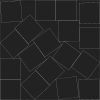
And the best known packing of 18 squares looks like this

Image Source: David Ellsworth
My algorithm that found the 18 square solution I presented took 2 days to converge on that solution. I had another instance of the algorithm that had been running with larger parameters, but after 3 weeks it still hadn't converged on a solution and my power company sent me an email about an "abnormality in power usage", which prompted me to pull the plug on the algorithm. I was hoping that by the time I am writing this blog post I would have found a new best configuration, however, it has been 2 months since I have developed the algorithm and I haven't found one so far.
While the results are quite disappointing, I believe there can be value in the discussion of how the square packing algorithm works.
Gensane and Ryckelynck's algorithm
Gensane and Ryckelynck's original algorithm works by trying to maximize the "inflation" of the squares. By inflation, I am referring to the scaling factor of a unit square such that there is no overlap between the other squares or the boundary.
Square-Square inflation
Let , , and , be the x position, y position, and rotation of a square respectively. The maximal inflation of between 2 unit squares such that they do not overlap is defined by where and are defined as
where is defined as
For a given configuration , the maximum inflation of all the squares is simply
Square-Boundary inflation
Given that the square must fit inside the boundary The max inflation of a square such that it doesn't exceed the boundary is defined as
For a given configuration , the maximum inflation of all the squares is simply
I won't discuss the proofs of these calculations but they can be found in the their original paper "Improved Dense Packings of Congruent Squares in a Square". The max inflation for the configuration is defined as
In their algorithm, they randomly sampled squares, applied a small "wiggle" to the squares, than compared how changed. If increased, the packing uses space more efficiently, and is a more optimal packing.
They repeated this process thousands of times on an single threaded 800 MHz CPU to find the optimal packing of 11 squares that we know today.
My implementation
One of the issues with their calculation is that calculating scales has a time complexity. The calculation complexity blows up when you try to use large N > 1000. To address this, I parallelized the calculation by implementing it with a cuda kernel.
First I wrote a few helper definitions
struct square {
    float position[2];
    float theta;
};

#define PI 3.14159265358979323846f
#define ROOT_TWO 1.41421356237309504880f

__device__ static float atomicMin(float* address, float val)
{
    int* address_as_i = (int*) address;
    int old = *address_as_i, assumed;
    do {
        assumed = old;
        old = ::atomicCAS(address_as_i, assumed,
            __float_as_int(::fminf(val, __int_as_float(assumed))));
    } while (assumed != old);
    return __int_as_float(old);
}

__device__ float signum_device(float x) {
    if (x < 0.0) return -1.0;
    return 1.0;
}
and then I wrote this kernel to solve for
__device__ float psi0_device(float a, float b, float theta, int thread_idx_x_local) {
    float idx = (float)thread_idx_x_local + 1.0;

    float thetai = theta + (PI / 4.0) + (0.5 * idx * PI);
    float f = 1.0f / fabsf(1.0f - (ROOT_TWO * signum_device(a * b) * sinf(thetai)));
    return (fabsf(a) + fabsf(b)) * f;
}

__device__ float psi_qq_device(float a0, float b0, float theta0, float a1, float b1, float theta1, int thread_idx_y_local, int thread_idx_x_local) {
    float t0 = a1 - a0;
    float t1 = b1 - b0;

    if (thread_idx_y_local == 0) {
        return psi0_device((t0 * cosf(theta0)) + (t1 * sinf(theta0)), (-t0 * sinf(theta0)) + (t1 * cosf(theta0)), theta1 - theta0, thread_idx_x_local);
    } else if (thread_idx_y_local == 1) {
        return psi0_device((-t0 * cosf(theta1)) + (-t1 * sinf(theta1)), (t0 * sinf(theta1)) + (-t1 * cosf(theta1)), theta0 - theta1, thread_idx_x_local);
    }

    return FLT_MAX;
}
In this kernel thread_idx_x_local is from
and thread_idx_y_local = 0 represents and thread_idx_y_local = 1 represents
and I also implemented similarly as
#define maxabs(a, b) (fmaxf(fabsf(a), fabsf(b)))

__global__ void calculatePhiKernel(square* squares, int numSquares, float l_bound, float* finalPhis) {
    int idx = blockIdx.x * blockDim.x + threadIdx.x;

    if (idx < numSquares) {
        finalPhis[idx] = (l_bound - maxabs(squares[idx].position[0], squares[idx].position[1])) / maxabs(cosf(squares[idx].theta), sinf(squares[idx].theta));
    }
}
and then I copied a common min reduction kernel
__global__ void reduceMinKernel(float* input, int inputSize, float* output) {
    __shared__ float s_min[256];

    int tid = threadIdx.x;
    int i = blockIdx.x * blockDim.x + threadIdx.x;

    if (i < inputSize) {
        s_min[tid] = input[i];
    } else {
        s_min[tid] = FLT_MAX;
    }
    __syncthreads();

    for (unsigned int s = blockDim.x / 2; s > 0; s >>= 1) {
        if (tid < s && i + s < inputSize) {
            if (s_min[tid + s] < s_min[tid]) {
                s_min[tid] = s_min[tid + s];
            }
        }
        __syncthreads();
    }

    if (tid == 0) {
        atomicMin(output, s_min[0]);
    }
}
and finally executed the kernels to solve for
extern "C" float calculateOmega(square* h_squares, int numSquares, float l_bound) {
    square* d_squares;
    float* d_finalPairPsiQQs;
    float* d_overallMinPsiQQ;
    float* d_finalPhis;
    float* d_overallMinPhi;

    long long totalUniquePairs = (long long)numSquares * (numSquares - 1) / 2;
    if (totalUniquePairs == 0) return FLT_MAX;
    if (numSquares == 0) return FLT_MAX;

    cudaMalloc(&d_squares, sizeof(square) * numSquares);
    cudaMalloc(&d_finalPairPsiQQs, sizeof(float) * totalUniquePairs);
    cudaMalloc(&d_overallMinPsiQQ, sizeof(float));
    cudaMalloc(&d_finalPhis, sizeof(float) * numSquares);
    cudaMalloc(&d_overallMinPhi, sizeof(float));

    cudaMemcpy(d_squares, h_squares, sizeof(square) * numSquares, cudaMemcpyHostToDevice);

    float host_initial_min = FLT_MAX;
    cudaMemcpy(d_overallMinPsiQQ, &host_initial_min, sizeof(float), cudaMemcpyHostToDevice);
    cudaMemcpy(d_overallMinPhi, &host_initial_min, sizeof(float), cudaMemcpyHostToDevice);

    dim3 threadsPerBlockPsi(4, 2);
    int threadsPerBlock_reduce = 256;
    calculatePairPsiQQKernel<<<totalUniquePairs, threadsPerBlockPsi>>>(d_squares, numSquares, d_finalPairPsiQQs);
    int blocksPerGrid_reduce = (totalUniquePairs + threadsPerBlock_reduce - 1) / threadsPerBlock_reduce;
    reduceMinKernel<<<blocksPerGrid_reduce, threadsPerBlock_reduce>>>(d_finalPairPsiQQs, totalUniquePairs, d_overallMinPsiQQ);

    int blocksPerGridPhi = (numSquares + threadsPerBlock_reduce - 1) / threadsPerBlock_reduce;

    calculatePhiKernel<<<blocksPerGridPhi, threadsPerBlock_reduce>>>(d_squares, numSquares, l_bound, d_finalPhis);
    reduceMinKernel<<<blocksPerGridPhi, threadsPerBlock_reduce>>>(d_finalPhis, numSquares, d_overallMinPhi);

    cudaDeviceSynchronize();

    float h_overallMinPhi;
    cudaMemcpy(&h_overallMinPhi, d_overallMinPhi, sizeof(float), cudaMemcpyDeviceToHost);

    float h_overallMinPsiQQ;
    cudaMemcpy(&h_overallMinPsiQQ, d_overallMinPsiQQ, sizeof(float), cudaMemcpyDeviceToHost);

    cudaFree(d_squares);
    cudaFree(d_finalPhis);
    cudaFree(d_overallMinPhi);
    cudaFree(d_finalPairPsiQQs);
    cudaFree(d_overallMinPsiQQ);

    return fminf(h_overallMinPhi, h_overallMinPsiQQ);
}
The full implementation I used to find my configuration of 18 squares is available at this github repo.